Here's something fitness marketers don't want you to know: six out of ten people quit their workout programs before hitting the two-month mark. The problem isn't willpower—it's that most routines require gym memberships, pricey equipment, or ninety-minute time commitments. Strip away those obstacles with a bodyweight workout routine, and suddenly you've got something sustainable that builds legitimate strength using nothing but gravity and your own mass.
Why Bodyweight Training Delivers Real Results
Think bodyweight exercises are just for beginners? Gymnasts who can hold iron crosses and front levers might disagree. When you manipulate angles and leverage, your body becomes a surprisingly heavy load—often delivering 60-80% of what you'd experience with commercial weight machines.
The Journal of Strength and Conditioning Research published findings showing experienced trainees maintained their muscle size and strength for months using only bodyweight movements. The secret? They constantly adjusted movement speed, depth, and difficulty rather than mindlessly repeating the same exercises.
Here's what makes functional training exercises different from machine work: biomechanists call them "closed kinetic chain movements," which is fancy terminology for "your hands or feet stay planted while you move." A push-up forces your entire core to work overtime preventing your spine from sagging while your chest, shoulders, and triceps handle the pressing. Now picture a chest press machine—you're lying against a padded backrest that does all the stabilization work for you. You're stronger in real life with the push-up pattern, even if the machine lets you move more weight.
The metabolic demand tells another story. According to a 2019 paper in the International Journal of Exercise Science, circuit-based calisthenics jacked heart rates up to 75-85% of max while still building muscle. That's conditioning and strength in one session—try getting that from a traditional bodybuilding split.
And bodyweight training scales forever. Can't manage a floor push-up today? Put your hands on a kitchen counter. Getting bored with regular squats? Try pistol squats on one leg or add explosive jumps. Whether you're rehabbing an injury or working toward advanced gymnastics skills, this adaptability keeps your bodyweight workout routine relevant for years.
Essential Exercises for Your First Month
These foundational movements build coordination patterns you'll use in every advanced skill later. Rush past them and you'll hit frustrating plateaus within months.
Upper Body Fundamentals
Author: Jessica Taylor;
Source: thelifelongadventures.com
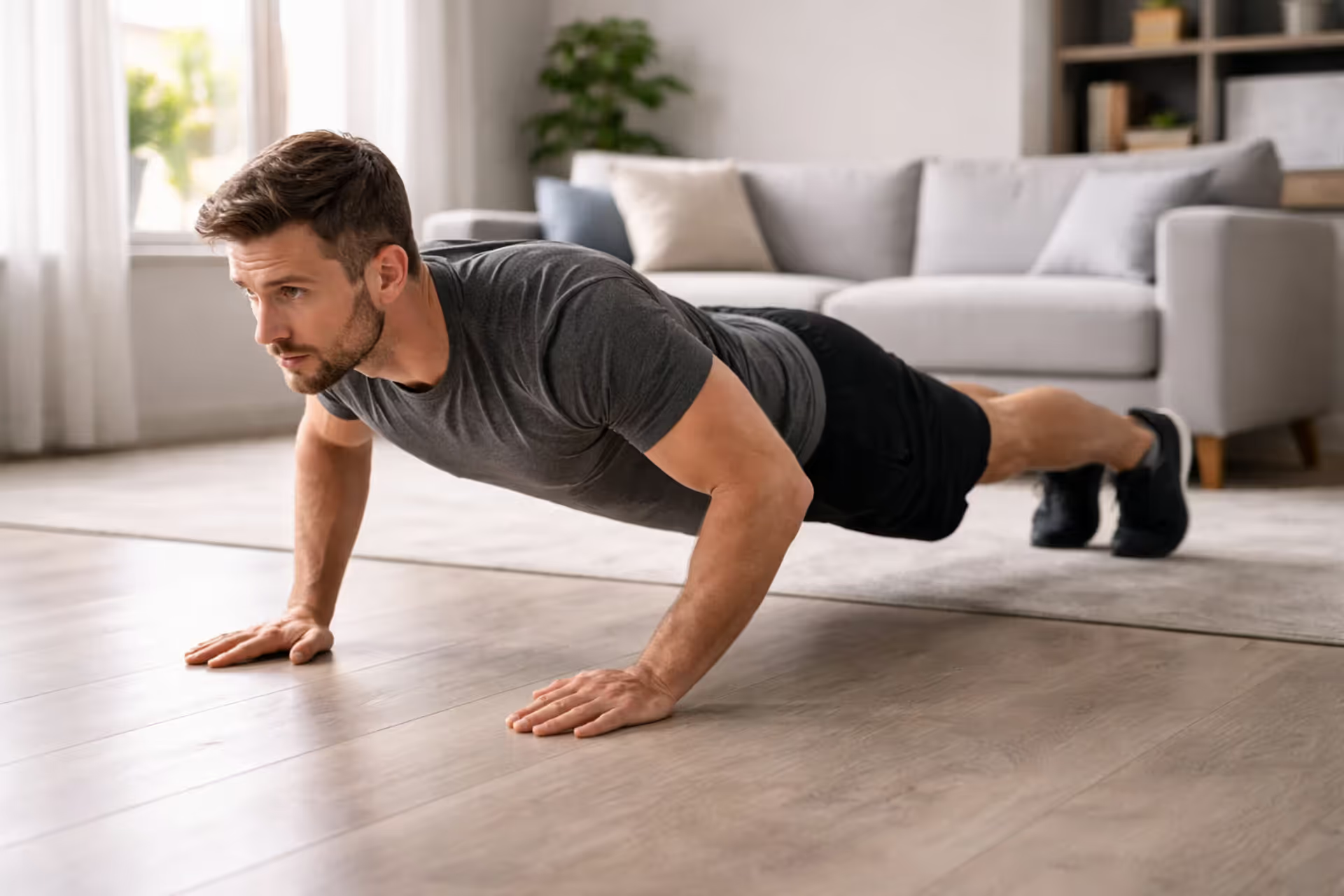
Push-ups form the foundation of any home strength workout. Place your hands just outside shoulder width, keep your body rigid as a plank from skull to ankles, and lower your chest until it hovers an inch off the floor. Three mistakes kill most people's progress: elbows shooting out past 45 degrees (hello, shoulder pain), hips dropping toward the floor (weak core), and half-reps that skip the hardest bottom portion where muscles actually grow.
Can't do floor push-ups yet? Elevate your hands on something sturdy—a table, countertop, or even a wall. Higher hand placement equals less bodyweight resistance. Drop the height by a few inches each week until you're on the ground.
Pike push-ups shift the workload onto your shoulders. Get into a downward-dog position—hips high, hands shoulder-width, creating an inverted V-shape with your body. Bend your elbows to lower the crown of your head toward the floor, then press back up. Straighten your legs as much as your hamstrings allow. This prepares your shoulders for handstand push-ups down the road while building overhead strength.
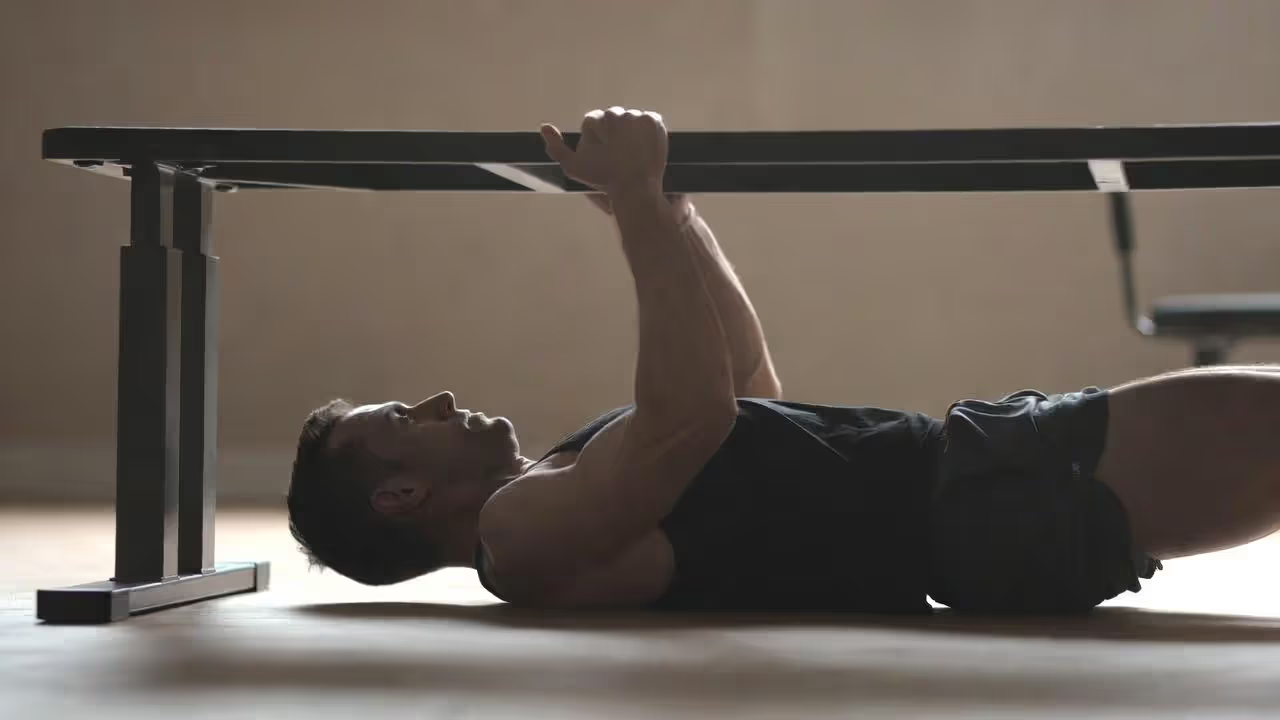
Inverted rows balance all that pressing work. Find a sturdy table edge, a low bar at a playground, or even a broomstick wedged between two chairs. Lie underneath, grab it, and pull your chest upward while keeping your body straight as a board. This horizontal pull prevents the rounded-shoulder posture that develops when you only do push-ups.
Lower Body Staples
Author: Jessica Taylor;
Source: thelifelongadventures.com
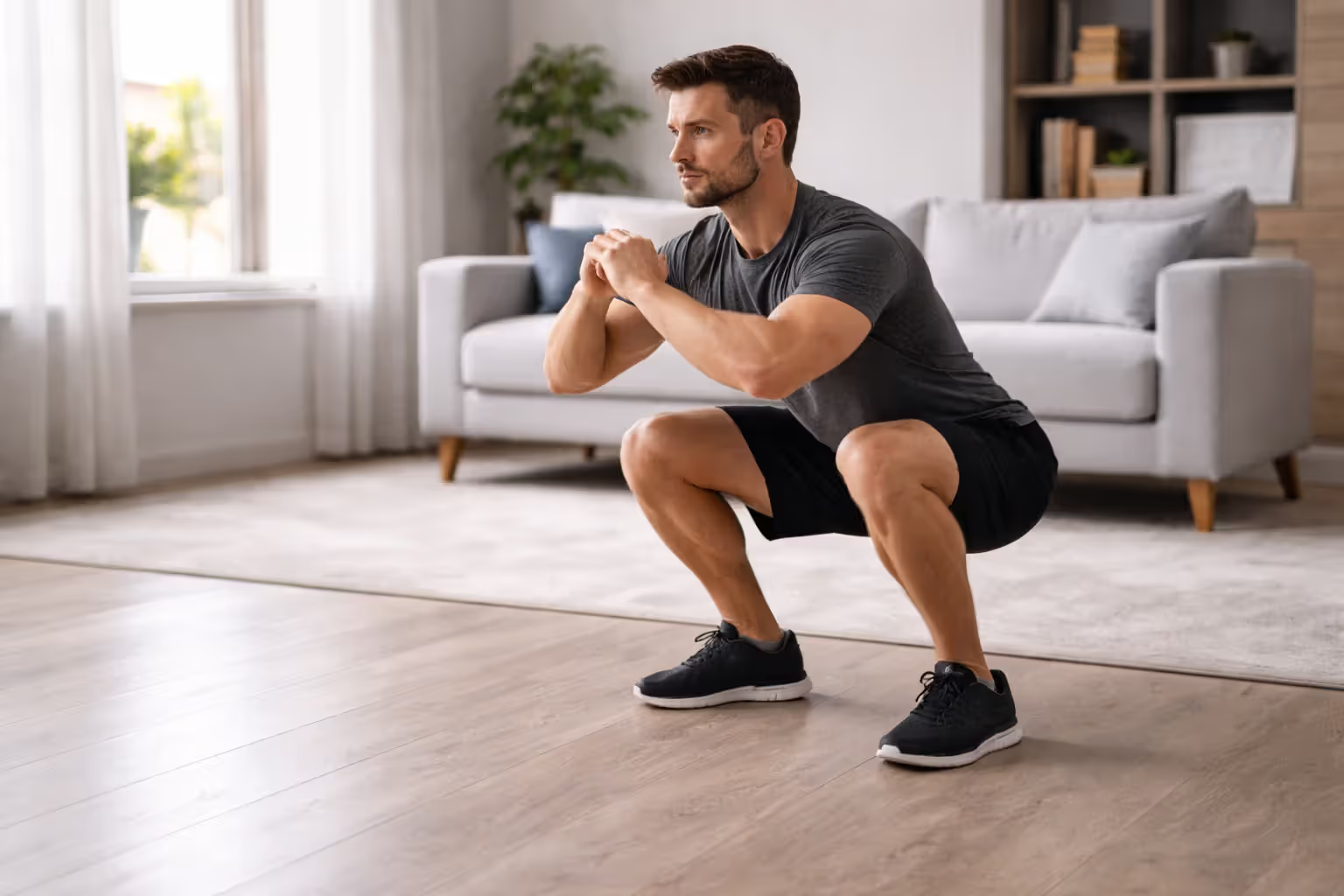
Bodyweight squats teach the hip hinge pattern that protects your back during every athletic movement. Set your feet about hip-distance, angle your toes out slightly. Sit your hips backward like you're aiming for a chair, chest stays upright, knees track over your toes. Drop until your hip crease passes below your knees, then stand by driving through your entire foot.
The mistake that wrecks knees? Letting them collapse inward as you stand up—it torques your knee ligaments dangerously. Film yourself from straight ahead; your knees should track in line with your middle toes throughout every rep.
Reverse lunges build single-leg strength without beating up your knees like forward lunges do. Step one foot backward, drop that rear knee toward the ground while keeping your front shin vertical. Press through your front foot to stand back up. Most people discover one leg is dramatically weaker—completely normal, and exactly why single-leg work matters.
Glute bridges wake up your posterior chain muscles that shut down from sitting all day. Lie on your back, bend your knees, plant your feet flat. Press through your heels and lift your hips until you form a straight line from knees through shoulders. Contract your glutes hard for a two-count at the top. Too easy? Do them one leg at a time.
Core Stability Movements
Author: Jessica Taylor;
Source: thelifelongadventures.com
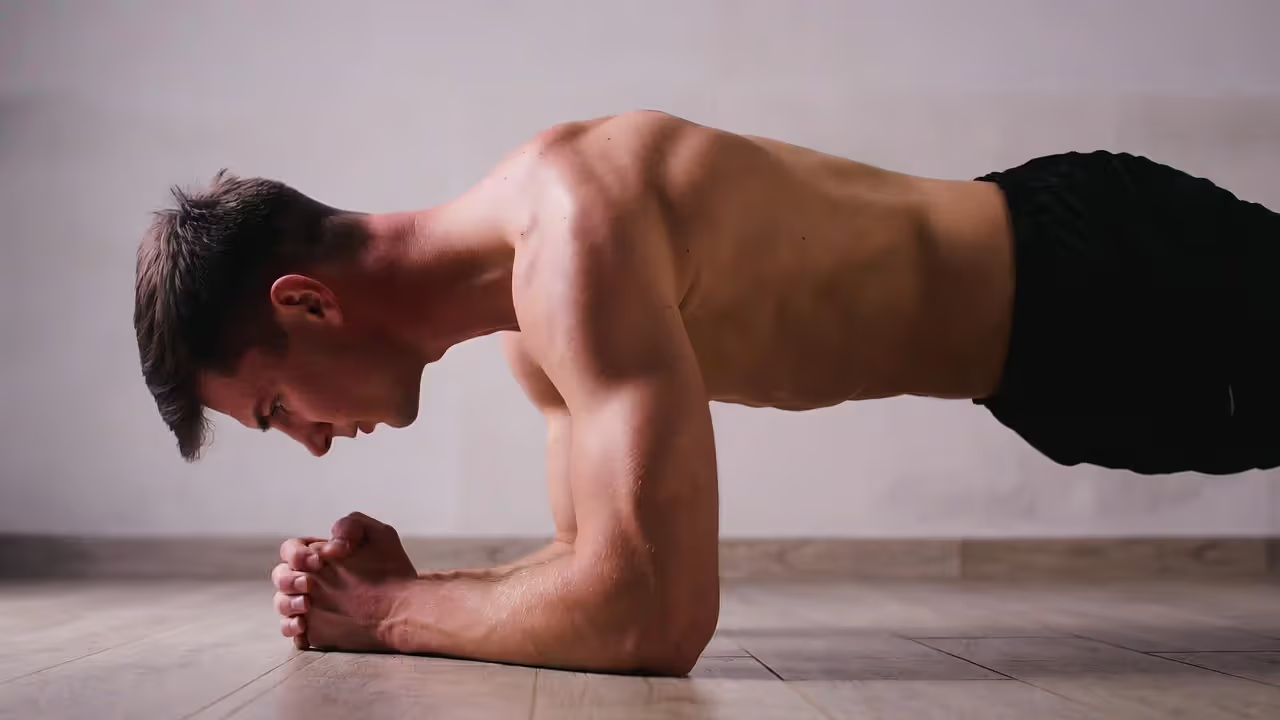
Planks develop anti-extension core strength—the ability to resist your spine from arching under load. Get into a push-up position but drop to your forearms, body rigid as steel. Beginners hold their breath or let their hips sag. Instead, breathe normally and brace like someone's about to punch your stomach—that tension is what you want.
Start with three rounds of 20-30 seconds. Once you hit 60 seconds with flawless form, make it harder: lift one foot, tap your shoulders alternating sides, or raise your arms overhead.
Dead bugs teach coordinated core control while flat on your back. Extend your arms toward the ceiling, bend your knees to 90 degrees with shins parallel to the floor. Lower your right arm overhead while straightening your left leg, hovering it just off the ground. Return to start, then switch sides. Your lower back must stay glued to the floor—any arch means you've gone beyond your current capacity.
Bird dogs challenge anti-rotation stability from a quadruped position. Start on all fours. Extend your right arm straight ahead and left leg straight back simultaneously, forming one line. Hold for three seconds, return, repeat on opposite sides. This strengthens the deep spinal stabilizers that prevent lower back pain.
Exercise Name
Primary Muscles
Difficulty Level
Beginner Reps/Sets
Common Form Errors
Push-ups
Chest, triceps, shoulders, core
Beginner-Intermediate
3 × 8-12
Elbows flaring wide, hips sagging, cutting depth short
Bodyweight Squats
Quads, glutes, hamstrings
Beginner
3 × 15-20
Knees collapsing inward, heels coming up, stopping too high
Inverted Rows
Lats, rhomboids, biceps
Beginner
3 × 8-12
Body sagging, incomplete pull, shrugging shoulders up
Reverse Lunges
Quads, glutes, hamstrings
Beginner
3 × 10 each leg
Front knee drifting over toes, poor balance, rushing through reps
Plank
Entire core, shoulders
Beginner
3 × 20-40 sec
Hips dropping, holding breath, letting head hang
Glute Bridge
Glutes, hamstrings, lower back
Beginner
3 × 15-20
Overarching lower back, pushing through toes only, speeding through reps
Pike Push-ups
Shoulders, upper chest, triceps
Intermediate
3 × 6-10
Knees excessively bent, cutting range short, elbows flaring
Dead Bug
Deep core stabilizers
Beginner
3 × 8 each side
Back arching off floor, moving too fast, holding breath
3-Day Weekly Schedule for Beginners
This beginner calisthenics plan structures your week so you hit all major muscle groups twice while recovering fully between sessions. Each full body bodyweight workout takes 30-40 minutes including warm-up and cool-down.
Spend five minutes before training on dynamic prep: arm circles, leg swings, hip rotations, jogging in place. This raises tissue temperature and cuts injury risk more effectively than old-school static stretching.
Follow the exercise order as written. It alternates pushing and pulling movements, which lets partially fatigued muscle groups recover while you work different ones. Push-ups followed immediately by squats, for instance, gives your upper body a break while your legs take over.
Rest periods matter more than most people realize. Ninety seconds lets your phosphocreatine energy system recharge about 90%, so you maintain quality reps across all sets. Cut rest to 30-45 seconds and you've shifted into conditioning territory—valuable, but different from pure strength development.
After your last exercise, spend five minutes on static stretching: hold each major muscle group for 30 seconds. Hit chest stretches in a doorway, hip flexor stretches, hamstring stretches. Your tissues are warm and pliable post-workout, making this the ideal time to improve flexibility.
Keep a simple workout log: date, exercises performed, sets, reps completed, how you felt. Four weeks later, you'll see concrete progress—many people double their push-up capacity or finally hold a plank for a full minute.
We are what we repeatedly do. Excellence, then, is not an act, but a habit.
— Will Durant
Intermediate 4-Week Progression Plan
Once you've completed three weeks of the beginner schedule without excessive soreness or joint pain, you're ready for harder variations. This calisthenics workout progression uses progressive overload—gradually cranking up training stress to force adaptation.
Week 1: Add Tempo Manipulation
Slow your eccentric (lowering) phase to four seconds. On push-ups, take four full seconds lowering your chest, then press up at normal speed. This time-under-tension increase recruits more muscle fibers without adding reps. Keep the same exercises and rep ranges but add this tempo to two exercises per workout.
Week 2: Increase Volume
Add one set to each exercise—going from three sets to four represents a 33% volume jump. Your workouts will stretch to 40-50 minutes. Can't complete all four sets with solid form? That's valuable feedback. Stick with three sets for that movement while progressing others.
Week 3: Introduce Advanced Variations
Swap one beginner exercise per workout for a harder version. Replace regular push-ups with diamond push-ups (hands forming a diamond under your chest, hammering your triceps). Trade bodyweight squats for Bulgarian split squats (rear foot elevated on a chair). Substitute standard planks for plank-to-down-dogs (drive hips up and back, then return to plank). These variations increase mechanical tension on your muscles.
Week 4: Density Training
Keep the same exercises and sets from Week 3, but slash rest periods to 60 seconds. You're performing more work in less time, improving both strength and work capacity. This also prepares you for circuit-style training if that interests you.
Throughout this progression, prioritize movement quality over hitting rep targets. Eight perfect push-ups build more strength than fifteen sloppy ones with sagging hips and shallow depth. Video yourself weekly—you'll catch form improvements that feel invisible in the moment.
Programming Mistakes That Stall Progress
Training to failure on every set feels hardcore but actually hammers your recovery and jacks up injury risk. Research shows stopping each set 1-2 reps before complete failure produces similar strength gains with less systemic fatigue. Keep max-effort attempts for periodic testing, not your regular Tuesday workout.
Ignoring bilateral strength imbalances lets your dominant side compensate during two-limbed movements like squats and push-ups. Six months of this creates visible asymmetries and dysfunctional movement patterns. Test yourself monthly: do single-leg exercises and single-arm planks. If one side is noticeably weaker, throw in extra sets for that limb until things balance out.
Skipping deload weeks creates accumulated fatigue that looks like a plateau. Every fourth or fifth week, cut your training volume by 40-50%. Do only two sets per exercise or drop one workout from your week. This strategic reduction lets your body fully recover and supercompensate—often you'll come back stronger when normal training resumes.
Neglecting mobility work creates artificial strength ceilings. Limited ankle flexibility prevents deep squats. Tight shoulders restrict overhead movements. Spend ten minutes three times weekly on targeted mobility: deep squat holds, shoulder pass-throughs with a broomstick, hip flexor stretches. Improved range of motion unlocks exercise progressions that were previously off-limits.
Following random workout videos instead of a structured program prevents progressive overload. Entertainment-focused content prioritizes novelty over systematic progression. You need repeated exposure to the same movements with gradually increasing difficulty, not constant variety chasing. Commit to a program for at least eight weeks before judging its effectiveness.
How to Track Strength Gains Without Weights
Traditional gym training offers obvious metrics—you benched 135 last month, 145 today. A home strength workout requires different measurement strategies.
If you can’t measure it, you can’t improve it.
— Peter Drucker
Rep progression provides the simplest tracking method. Performed 8 push-ups four weeks ago and hit 15 today? You've built strength. Record your max reps for each exercise monthly. Target 10-20% increases every 4-6 weeks. Stagnant numbers mean you need to adjust training variables: volume, intensity, or exercise selection.
Time-under-tension benchmarks work perfectly for isometric holds. Track how long you can hold a plank with perfect form. Progressing from 30 seconds to 90 seconds represents a 200% improvement in core endurance-strength. Similarly, time your wall sits, L-sit holds, or single-leg balance drills.
Exercise progression ladders create clear advancement paths. You might climb: incline push-ups → standard push-ups → diamond push-ups → decline push-ups → pseudo-planche push-ups → full planche push-ups. Each step represents measurable strength increase. Chart your position on these ladders for various movement patterns.
Body composition measurements reveal changes that performance metrics might miss. Take monthly photos in consistent lighting wearing the same outfit. Measure your waist, chest, arms, and thighs with a fabric tape. Muscle gain and fat loss often occur simultaneously during your first six months of training, keeping scale weight stable while dramatically improving how you look.
Workout density calculations track total work capacity. Record your workout duration, then calculate: (total sets × total reps) ÷ workout minutes. Completed 180 total reps in 35 minutes last month (5.14 reps/minute) and now finishing 200 reps in 33 minutes (6.06 reps/minute)? You've improved work capacity by 18%.
Resting heart rate monitoring indicates improved cardiovascular fitness and recovery capacity. Measure your pulse immediately upon waking, before getting out of bed. A 5-10 beat per minute decrease over several months suggests improved cardiac efficiency and better training adaptation.
Author: Jessica Taylor;
Source: thelifelongadventures.com
Create a simple spreadsheet tracking these metrics. Review monthly to identify trends. Seeing concrete progress sustains motivation during plateaus that feel discouraging day-to-day. Remember that strength gains follow a logarithmic curve—rapid initial improvements followed by slower but steady progress. That's normal adaptation, not program failure.
Frequently Asked Questions
How many days per week should I do bodyweight workouts?
Three to four days weekly hits the sweet spot for most people. This frequency allows 48-72 hours between sessions—the window when muscle protein synthesis peaks and strength adaptations lock in. Training more than five days weekly usually leads to accumulated fatigue without additional gains. Feeling energized and recovering well? Four days works. Frequently sore or dreading workouts? Three days is smarter. Let your body's recovery signals guide you rather than arbitrary frequency rules.
Can you build muscle with only bodyweight exercises?
Absolutely, assuming you progressively increase difficulty rather than endlessly adding reps. Muscle growth requires mechanical tension, metabolic stress, and muscle damage—all achievable through calisthenics. Once you hit 20+ reps of any exercise, transition to a harder variation instead of chasing higher rep counts. Someone doing single-arm push-ups will build more chest muscle than someone cranking out 100 standard push-ups. The key is maintaining the 6-15 rep range by continuously progressing to more challenging movements.
How long until I see results from calisthenics?
Neurological adaptations produce strength gains within 2-3 weeks—exercises feel easier and you'll crank out more reps. Visible muscle definition typically shows up at 6-8 weeks with consistent training and adequate protein intake. Significant body composition changes require 12-16 weeks. These timelines assume you're training three times weekly, eating sufficient protein (0.7-1 gram per pound of bodyweight), and sleeping 7-9 hours nightly. Poor nutrition or sleep can easily double these timelines.
What if I can't do a single push-up yet?
Begin with wall push-ups: stand arm's length from a wall, place your palms against it, and perform pushing movements. After one week, move to countertop push-ups with hands elevated 36-40 inches. Each week, drop your hand height by finding progressively lower surfaces: dining table, kitchen chair, stair step, floor. Most people reach floor push-ups within 4-6 weeks using this approach. Alternatively, do push-ups from your knees, but focus on maintaining a rigid body line from knees through shoulders—don't let your hips sag.
Should I do bodyweight training before or after cardio?
Hit strength work first when your nervous system is fresh. Fatigue from running or cycling impairs coordination and force production, reducing your strength exercise quality. Want to combine both in one session? Do your bodyweight routine first, then tack on 15-20 minutes of moderate cardio. Better yet, separate them entirely: strength training on Monday/Wednesday/Friday, cardio on Tuesday/Thursday/Saturday. This separation optimizes both training adaptations.
Do I need rest days between workouts?
Yes—rest days are when your body actually constructs strength. During workouts, you create microscopic muscle damage and deplete energy stores. The subsequent 48-72 hours allow tissue repair, glycogen replenishment, and neuromuscular adaptation. Training the same muscle groups daily prevents this recovery process, leading to stagnation or regression. Active recovery (walking, light stretching, recreational activities) on off days enhances blood flow without creating additional training stress. At minimum, take one complete rest day weekly where you do nothing more strenuous than normal daily activities.
Building strength without equipment isn't settling—it's a legitimate training methodology that produces measurable results when you follow structured progression principles. The exercises outlined here provide everything needed to develop functional strength, improve body composition, and build the movement foundation for more advanced skills.
Begin with the beginner schedule, master proper form on foundational exercises, and progress systematically by manipulating tempo, volume, and exercise difficulty. Track your performance metrics monthly to maintain motivation and identify when to adjust your program. Most importantly, prioritize consistency over intensity. Three moderate workouts weekly for six months will transform your physique and strength more than sporadic intense sessions scattered across the same timeframe.
Your body is the most accessible, versatile training tool you'll ever own. Learning to use it effectively opens lifelong fitness possibilities that don't depend on gym memberships, expensive equipment, or specific locations. Whether you're traveling, working long hours, or simply prefer training at home, a well-designed bodyweight workout routine delivers results that rival any commercial gym program.
Every person confidently loading plates once stood exactly where you are — confused and uncertain. This guide bridges that gap with seven fundamental lifting techniques, a complete 8-week plan progressing from foundation to overload, essential gear vs. marketing waste, how to pick starting weights, five mistakes that destroy beginner progress, and tracking methods that reveal real gains the scale
Research shows eight weeks of band training produces strength gains statistically identical to free weights — yet bands cost $30-50 total with zero commute. This guide covers how variable resistance builds muscle, a band selection table by type and tension, 12 essential exercises with form cues, three structured plans for beginners through fat loss, progression tactics without traditional weights,
Each inch your head drifts forward adds ten pounds of stress to your neck — and "sit up straight" exhausts you in fifteen minutes. This guide delivers a 5-minute desk routine you can do seated, a complete back strengthening workout hitting every muscle that holds you upright, an 8-week progressive schedule, common form mistakes that make posture worse, and tracking methods that prove your progress
Your PRs stalled, sleep feels useless, and you're snapping at coworkers — these aren't character flaws, they're overtraining red flags. This guide covers 12 physical and mental warning signs from elevated resting heart rate to hormonal disruption, who's most at risk, a science-backed recovery protocol for the first critical weeks, training load monitoring tools including HRV tracking, and the prev
The content on this website is provided for general informational and educational purposes related to health, yoga, fitness, and overall wellness. It is not intended to replace professional medical advice, diagnosis, or treatment.
All information, workout suggestions, yoga practices, nutrition tips, and wellness guidance shared on this site are for general reference only. Individual health conditions, fitness levels, and medical needs vary, and results may differ from person to person. Always consult a qualified healthcare provider before starting any new exercise program, dietary plan, or wellness routine.
We are not responsible for any errors or omissions, or for any outcomes resulting from the use of information presented on this website. Your health and fitness decisions should always be made in consultation with appropriate medical and fitness professionals.